Comprehensive Monitoring System
An AEDC Extension Project
Today, children and young people face futures that are filled with promise but also considerable challenge. They face a growing global burden of mental health problems and a rapidly changing world. The challenge is to not only to protect the emotional wellbeing of young people but also to prepare them for future adversities not yet fully apparent.
To do this effectively we need comprehensive data mapping social and emotional development, at a whole of population level, from early childhood to young adulthood. The best we have, currently, is a patchwork of disconnected data, at different ages, using different indicators. This means we are ‘flying blind’ when it comes to delivering programs to reduce mental disorder and grow future global citizens.
We have addressed this data gap by building a new Comprehensive Monitoring System (CMS) designed to map each age and stage of development, from early childhood to young adulthood, across eight developmentally interconnected census surveys, separated by 3-year intervals, and delivered through universal services serving each age group.
The CMS has been specifically designed to extend the reach of the highly successful Australian Early Development Census (AEDC), which is a federally funded, triennial, census of more than 300,000 school-aged children (5-6 years) that captures over 95% of all children this age across Australia. The aim is to develop a government-ready system which could eventually be rolled out state-wide, or nationally.
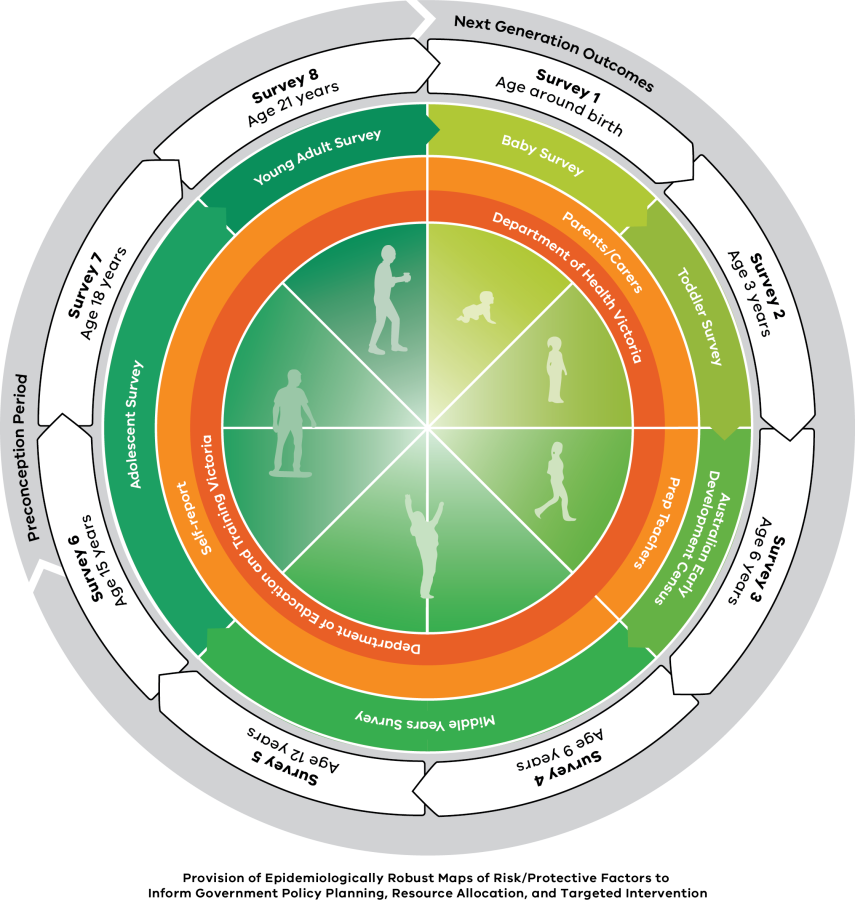
Surveys within the CMS have been developmentally sequenced using findings from some of Australia’s most mature life-course and intergenerational cohort studies of emotional life, the oldest of which now spans four decades and crosses three generations. The scientific integrity of indicators is strengthened by machine learning based (living) systematic reviews of the global cohort literature.
In addition, through the CMS, community and government planners are provided with a menu of evidence-based interventions to guide investment choices for responding to early life course risk and resilience profiles measured through Comprehensive Monitoring. The scientific integrity of this menu is maintained by machine learning based (living) systematic reviews of the global trials literature.
Since 2015, the infant, toddler, and middle years surveys have been successfully trialled multiple times in pilot sites across Victoria. Investment in this vision by the Victorian Government at a time of fiscal austerity is highly significant; it represents commitment to the broader goal and signifies substantial opportunity for project expansion to national partners in the future.
The first phase of the system has been successfully trialled in the Loddon-Mallee Region in Northwestern Victoria. The full system is now ready to be tested within larger and more diverse communities, including rural, regional, and metropolitan.
The CMS represents a partnership between the Deakin University Lifespan Institute and the Victorian Department of Education.
Details of the implementation of the Comprehensive Monitoring system can be found on our recently published CMS protocol paper available for download.
Following implementation, ACIL Allen Consulting was engaged by the Lifespan Institute and the Department of Education to undertake an evaluation of the Comprehensive Monitoring system trials in North Central Victoria. The CMS Trial Evaluation Report highlights the strengths, weaknesses, threats and opportunities of this project.
The Comprehensive Monitoring Surveys
The Comprehensive Monitoring System draws on existing surveys. These eight questionnaires focus on social and early emotional development at the community level and include population-level questions that are developmentally appropriate for different ages and stages of development.
Australian Early Development Census (AEDC):
The Australian Early Development Census (AEDC) is a national measure of young children’s development at the commencement of school (age 5) across five areas of early childhood development – physical health and wellbeing, social competence, emotional maturity, language and cognitive skills, and communication skills and general knowledge. The AEDC is based on the Canadian Early Development Instrument (EDI) and has been implemented nationally since 2009.
For more information about AEDC data, see the 2021 release here, or check out the 2024 results and more on the AEDC Data Hub.
Toddler Development Instrument (TDI):
The Toddler Development Instrument (TDI) is completed by parents of children age 16 – 20 months, and measures six constructs associated with children’s healthy development – social interactions and play; health, nutrition, and development; family/community resources and barriers; social environment and support; caregiver beliefs and wellbeing; and sociodemographic context. The TDI has been tested with parents, community leaders, and child development professionals, and shows potential to identify community strengths and improvement areas to ensure all children and their families have supports to realise the best possible start in life.
Middle Years Development Instrument (MDI):
The Middle Years Development Instrument (MDI) is a self-report measure for children ages 10 and 14 that asks about five areas of development – physical health and wellbeing, connectedness, social-emotional development, school experiences, and use of after school time – that are strongly associated with children’s health, well-being, and academic achievement. Like the AEDC, MDI data are used at a population level to understand the factors that promote children’s health and wellbeing for the purpose of informing policies, practices, and collaborations to improve children’s social and structural environments.
Our team has previously implemented the TDI and MDI in communities. This has provided us with valuable knowledge and feedback from communities, parents, educators and children. These learnings will enable the successful implementation of all seven surveys in the Comprehensive Monitoring System.
SEED POD Living Knowledge Portal
SEED POD gives families, schools and communities easy access to information on effective, evidence-based programs for promoting positive social and emotional development from early childhood to young adulthood.
The portal is based on a unique Living Knowledge Review System that scans the global literature to ensure that the best information worldwide is made available to you. Programs are rated by researchers based on the strength of scientific evidence available to support them. Highly rated programs are well suited to responding to challenges in your community.
Once a community has completed all Comprehensive Monitoring System (CMS) surveys, they can access the SEED POD Menu of Evidence Based Programs to find the ‘best fit’ interventions to address areas identified as in need of intervention, as well as to build on strengths highlighted by their results.
This system has been designed by Deakin University’s Lifespan Institute in collaboration with the Deakin Applied Artificial Intelligence Initiative, Deakin Library and Deakin Research Communications.
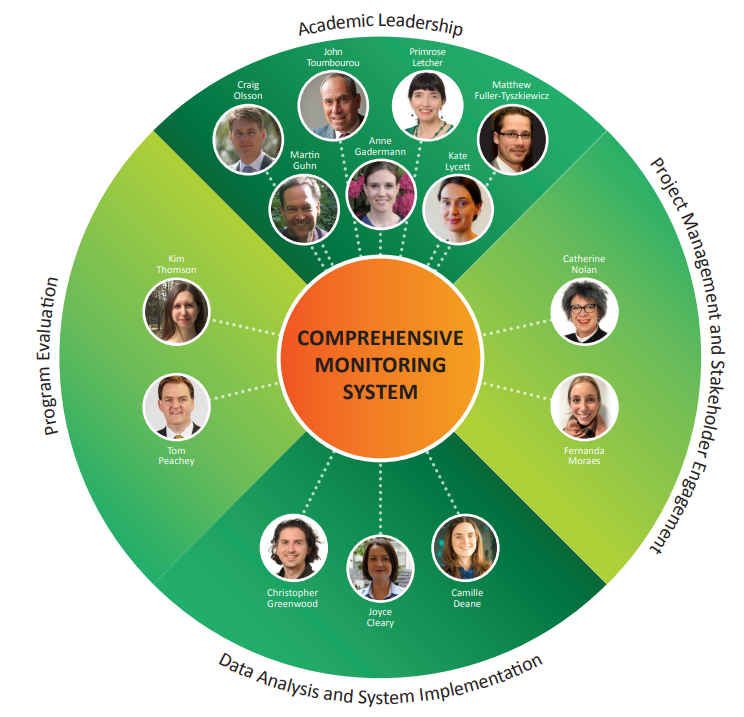
Our team
|
|
|
|
|
|
|
|
|
|
|
|
|
|
Partner organisations
We extend our thanks to the Shires of Loddon and Buloke for partnering with our team in 2020. The project is led by the Deakin Lifespan Institute at Deakin University, the Victorian Department of Education, and the Human Early Learning Partnership (University of British Columbia, Canada). The project is funded by the Ian Potter Foundation, National Health and Medical Research Council, and the Victorian Department of Education.

Contact us
For further enquiries, contact:
- Catherine Watkin Nolan, Comprehensive Monitoring Project Director and Victorian AEDC Coordinator on (03) 9651 3539 or [email protected]